Wound Closure
Summary
Wounds can be closed using: Primary, Secondary or Tertiary Intention. This will largely depend on the classification of the wound depending on its contamination.
How will you close the wound? In order to decide, you need to classify the wound according to clean, clean-contaminated, contaminated, and dirty. This category helps you identify which wounds are at the highest risk of post-closure infection.
Types of Wounds
- Primary Intention
- Secondary Intention
- Tertiary Intention
Primary Intention
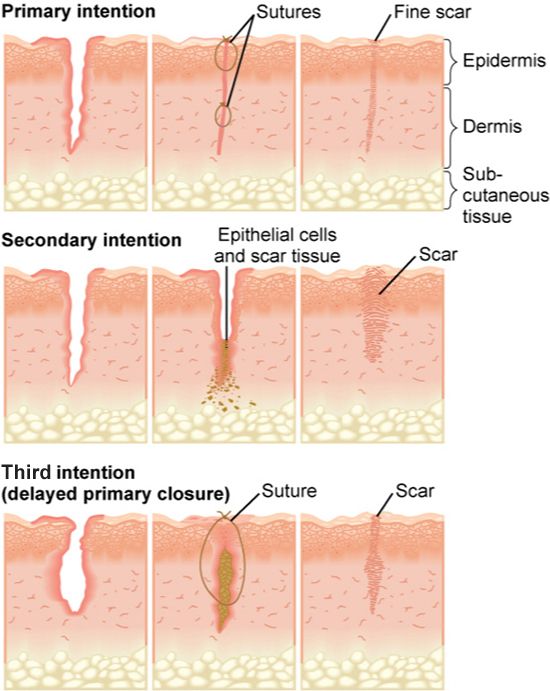
Closure by primary intention means that the wound is closed surgically (sutures, staples, or any other form or technique). This lowers the risk of infection and wound dehiscence. This often leads to quicker healing.
Wounds that may be closed using primary intention include:
- Clean wounds (there is no break in the sterile operative technique, often done as an elective)
- Clean-Contaminated wounds (in this wound an organ is entered but there is no or minimal spillage of that organ’s contents)
- Wounds closed within 4 hours of their development
- Wounds with very little tissue loss
- Wounds that can be closed with very little tension
Secondary Intention
The wound is not closed surgically. The edges of the wound are not brought together and hence there is a gaping irregular wound. The base of the wound often heals by developing granulation tissue and other findings may be noticeable such as slough. Once the wound heals sufficiently and most of the “gap” closes, the epithelium then ends up covering the wound. This is a slower healing process.
Wounds that may be closed using secondary intention include:
- Contaminated wounds (penetrating traumatic injuries, wounds with a break in the operative sterile technique, wounds with GIT spillage)
- Dirty wounds (wounds that have pus/stools eg an abscess, wounds from a perforated bowel, an “old” contaminated wound (>6 hours old)
- Wounds delayed in presentation (> 4 hours from the incident)
- Wounds with a large amount of tissue loss
- Wounds that will be closed with too much tension
- Wounds that have a high risk of post-closure infection
This explains one of the reasons that once a surgeon finds a perforated bowel, they close the fascia to prevent evisceration. However, they leave the rest of the abdominal layers open and they heal with secondary intention.
Third Intention
The wound is left open for a particular period of time, but after a while, the wound is closed in a similar way as it was done with primary intention. This closure may include using a skin graft, a skin flap, or any other skin substitute.
Wounds that may be closed using secondary intention include:
- The superficial portion of soft tissue wounds is left open to allow time for edema or infection to clear.
- In abdominal or pelvic area wounds where there was a perforated viscus found, only the abdominal wall’s fascia was closed initially to prevent evisceration, and the more superficial subcutaneous fat and skin were left open for a period of time to be closed later.
The wound is left open for a particular period of time, but after a while, the wound is closed in a similar way as in primary intention. This closure may include using a skin graft, a skin flap, or any other skin substitute.
Wounds that may be closed using secondary intention include:
1. Superficial portion of soft tissue wounds left open to allow time for edema or infection to clear
2. Abdominal or pelvic area wound where there was a perforated viscus found, only the abdominal wall’s fascia was closed initially to prevent evisceration, and the more superficial subcutaneous fat and skin were left open for a period of time to be closed later


Made with ❤️ by QuickBeat
We are a small education agency that aims to provide medical education.
EXPLORE
SERVICES
CONTACT
- Pretoria North, Gauteng
- contact@quickbeat.co.za