Antihistamines
Summary
This is a short summary on antihistamines.
Basics
Okay doctors, listen up! It seems like we don’t remember antihistamines well enough. Yet, we use them every single day. Let’s have a quick review.
Histamine is an amine, usually stored in mast cells, basophils, and other cells located in the lungs, skin, and most of our mucosas. Histamine is released when there is a trigger such as cold temperature, bacterial toxins, stings, trauma, and different forms of allergic reactions.
Once histamine is released, it binds to either an H1 or H2 receptor. H1 receptors are known to cause an increase in capillary permeability as well as smooth muscle contraction. H2 receptors help with mediating gastric acid secretion. Both use different intracellular pathways to achieve their desired effect. Ani-histamines work by competitive inhibition of the receptor at the target tissue.
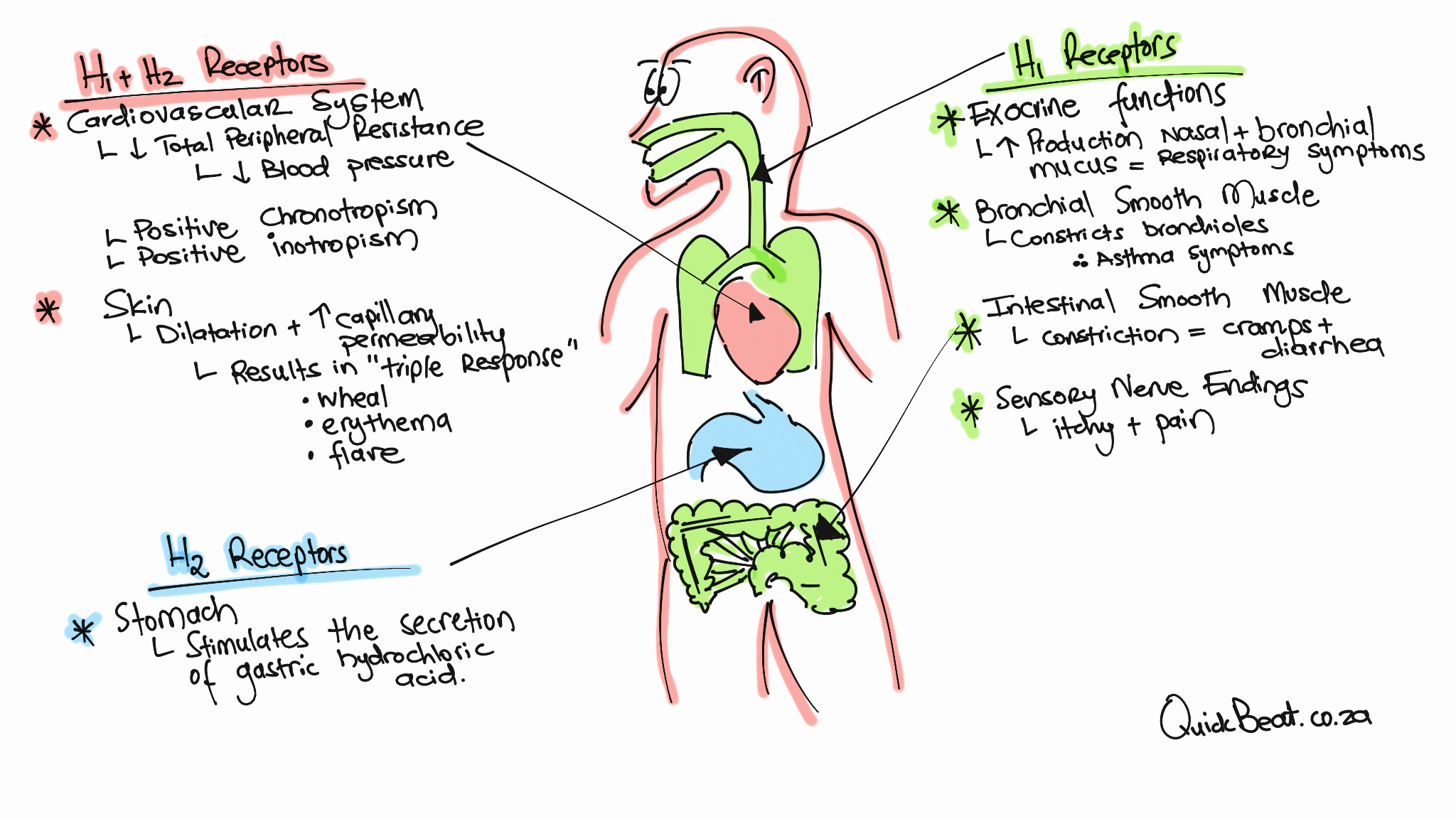
H1 Blockers
H1 blockers also block other receptors such as alpha-adrenergic receptors, cholinergic receptors, and serotonin receptors. Therefore, SIDE EFFECTS!
H1-blockers can be divided into the first and second generations. The first-generation agents are usually more affordable. The second-generation agents have fewer CNS side effects. These are some common H1 blockers you will hear about, especially when starting out as a young doctor.
- 1st Generation:
- Chlorpheniramine, Diphenhydramine (used for motion sickness), Promethazine (can really give sedation the patient – known as “a drowsy anti-histamine”).
- 2nd Generation:
- Cetirizine (Non-Sedating).
- Commonly known as Allergex.
- Uses: Urticaria, rhinitis.
- Dose: 4mg PO 4-6hourly (max 24mg/24hours)
- Commonly known as Betasleep or Sleepeze.
- Uses: Insomnia.
- Dose: 25-50mg PO nocte as needed. Taken around 20mins before going to bed. This agent should not be used on successive nights or for an extended period of time.
- Commonly known as Phenergan.
- Uses: Anaphylactic reactions, motion sickness, nausea, vomiting, pre/post operative sedation.
- Dose:
- Allergic conditions/Sedation: 25-50mg IV/IM (max 100mg/24hours).
- Nausea/Vomiting: 25mg with a maintenance of 10-25mg, 4-6 hourly as required.
- Vertigo/Motion sickness: 25mg IV/IM 12 hourly PRN.
- Commonly known as yoh, many trade names.
- Uses: allergic rhinitis, chronic idiopathic urticaria.
- Dose: 10mg PO OD (daily).
Therapeutic Uses
- Allergic conditions e.g. allergic rhinitis, urticaria – but not much for bronchial asthma. This is because histamines are the main mediators in the former conditions but several mediators are involved in the latter.
- Motion sickness, Nausea
- Insomnia
Side Effects
Because of the multiple receptor blockage, the following side effects occur.
1. Sedation, Tinnitus, Fatigue, Dizziness, Blurred vision, tremors. Sedation is less common with second-generation antihistamines.
2. Dry mouth (anti-cholinergic)
H2 Blockers
These are used in the treatment of gastric ulcers.
Drugs commonly used: Cimetidine and Ranitidine. We will talk more about these on another day!
- Can be given as PO, IV, IM.
- Uses: Heartburn, dyspepsia, gastric and duodenal ulcers, reflux esophagitis, and more.
- Dose:
- Heartburn/Dyspepsia: 200mg PO 6 hourly with meals for 14 days.
- Active ulcer: 200-400mg 6-8 hourly with meals for 4 weeks.
- Check other prescriptions on EMGuidance.
- Can be given as PO, IV, IM.
- Uses: Similar to Cimetidine.
- Dose:
- Treatment and Prevention of gastric/duodenal ulcers: 150-300mg PO OD for 4-12 weeks.
- Check other prescriptions on EMGuidance.
References and Further Reading
1. Whalen, K. (2015) “Antihistamines,” in Lippincott Illustrated Reviews Pharmacology. 6th edn. Wolters Kluwer, pp. 393–398.
2. Chlorpheniramine Maleate. Emguidance. Available at: https://emguidance.com/content/ 15028 (Accessed: December 18, 2022).
3. Diphenhydramine . Emguidance. Available at: https://emguidance.com/content/ 15926 (Accessed: December 18, 2022).
4. Promethazine. Available at: https://emguidance.com/content/ 15149 (Accessed: December 18, 2022).
5. Cetirizine . Available at: https://emguidance.com/content/ 16715 (Accessed: December 18, 2022).
6. Cimetidine . Available at: https://emguidance.com/content/ 15863 (Accessed: December 18, 2022).
7. Ranitidine . Available at: https://emguidance.com/content/ 15898(Accessed: December 18, 2022).
2. Chlorpheniramine Maleate. Emguidance. Available at: https://emguidance.com/content/ 15028 (Accessed: December 18, 2022).
3. Diphenhydramine . Emguidance. Available at: https://emguidance.com/content/ 15926 (Accessed: December 18, 2022).
4. Promethazine. Available at: https://emguidance.com/content/ 15149 (Accessed: December 18, 2022).
5. Cetirizine . Available at: https://emguidance.com/content/ 16715 (Accessed: December 18, 2022).
6. Cimetidine . Available at: https://emguidance.com/content/ 15863 (Accessed: December 18, 2022).
7. Ranitidine . Available at: https://emguidance.com/content/ 15898(Accessed: December 18, 2022).


Made with ❤️ by QuickBeat
We are a small education agency that aims to provide medical education.
EXPLORE
SERVICES
CONTACT
- Pretoria North, Gauteng
- contact@quickbeat.co.za