Scorpion Stings
Basics
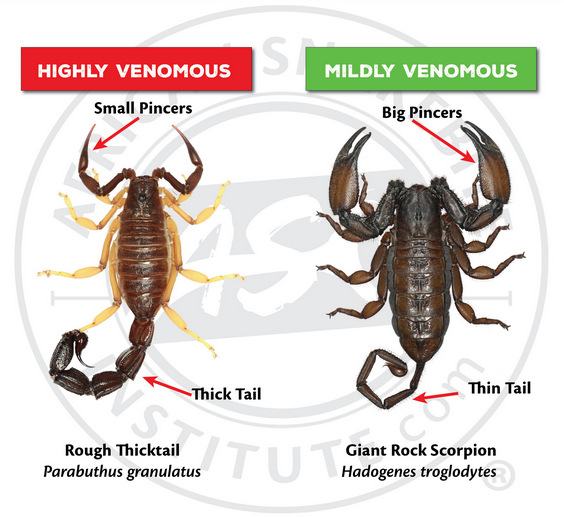
All scorpions are considered to be venomous, however, only around 25 out of the 1400+ species are considered to be life-threatening. One of the most important rules to keep in mind is that scorpions with thick tails and small pincers are by far more dangerous (venomous) than those with thin tails and large pincers. Scorpions may vary in colour and the degree of envenomation is not determined by their colour. There are two potentially life-threatening species in Southern Africa: Rough Thicktail Scorpion and the Transvaal Thicktail Scorpion. For these two scorpions, the anti-venom is effective.
The thick tail scorpions usually produce a neurotoxin, resulting in hyperexcitability (jerks, twitches, tremors, muscle spasms) and cranial nerve dysfunction (hypersalivation, blurry vision). Other symptoms may include autonomic dysfunction bradycardia and hypertension. The disease may progress and result in difficulty in breathing. Symptom onset may vary from 2 hours to 8 hours.
Presentation
- Pain and Paresthesia, local and surrounding the region affected..
- Autonomic dysfunction: Tachycardia
- Motor Dysfunction: Restlessness, uncontrollable jerking
- Cranial Nerve dysfunction, blurred vision, pharyngeal muscle incoordination, drooling
- Respiratory compromise
- Nausea, vomiting
- Others: cardiac dysfunction, pulmonary edema, pancreatitis
Management
Non-Pharmacological
- If the scorpion is not identified, or you suspect that it is a thick-tailed scorpion then observe the patient in the hospital for at least 12 hours.
- Monitor vitals
- Ensure you assess patient’s airway, breathing and circulation. Provide the patient with ventilator support if it is necessary.
Pharmacological
- Analgesia:
- Oral: Paracetamol 1g PO QID (15mg/kg/dose QID)
- Local: Inject lignocaine 2%, 2mls around the site of the sting as a form of local anesthetic
- NB: Opioids should ideally be avoided as they increase the risk of respiratory depression. If they do end up being used, the patient should be monitored closely.
- Muscular cramps:
- Calcium gluconate 10% IV 0.5ml/kg slowly IV, given as around 0.5-1ml/minute. You should monitor the patient’s ECG.
- Anti-Tetanus:
- Tetanus toxoid 0.5ml IMI stat, if the patient is not immunized in the past 5 years.
- Antivenom:
- It is only administered in patients with systemic signs. Patients may develop an anaphylactic response, hence one should be prepared to manage it if it does happen.
- Scorpion antivenin, is given slowly IV as 10ml administered over 3-5 minutes. It may be diluted with normal saline or 5% dextrose.
- Severe cases may also need to be treated in a intensive care unit.
2. Cut or suck the wound
3. Use ice or hot water
4. Be careful with antihistamines and opioids.
2. The National Department of Health, South Africa: Essential Drugs Programme. Primary Healthcare Standard Treatment Guideline and Essential Medicine List. 7th ed. South African National Department of Health; 2020.
3. African Snakebite Institute. 2022. Dangerous Scorpions of southern Africa. [online] Available at: [Accessed 12 September 2022].


Made with ❤️ by QuickBeat
We are a small education agency that aims to provide medical education.
EXPLORE
SERVICES
CONTACT
- Pretoria North, Gauteng
- contact@quickbeat.co.za